As an Amazon Associate, we earn from qualifying purchases. Some links on this site are affiliate links at no extra cost to you. Our recommendations are based on thorough research and editorial judgment.


Scratch Resistance: Mohs Scale Ratings for Case Surfaces

I explain that the Mohs hardness scale, ranging from talc (1) to diamond (10), quantifies scratch resistance of case surfaces by comparing them to reference minerals and everyday objects, noting that a steel nail (≈6.5 Mohs) scratches orthoclase but resists quartz, a copper penny (≈3–3.5 Mohs) scratches calcite but not fluorite, and an aluminosilicate glass screen (≈5.5–6.5 Mohs) aligns with quartz, allowing you to bracket an unknown material’s hardness between the lowest mineral that leaves a groove and the highest that does not, and to correlate those brackets with abrasion resistance and durability metrics, which you’ll explore further if you continue.
Key Takeaways
- Use a calibrated Mohs scratch kit (talc‑quartz) or everyday objects (steel nail ≈6.5, copper penny ≈3.5) to bracket case surface hardness.
- Record the lowest reference that produces a visible groove (upper bound) and the highest that fails to scratch (lower bound) to estimate the Mohs rating.
- Typical case materials: polymer coatings ≈3–4, aluminum alloy ≈5–6, stainless steel ≈6.5–7, tempered glass ≈5.5–6.5.
- Ensure consistent force (~0.5 N), clean flat testing area, and blind markings to avoid operator bias and improve repeatability.
- Correlate the obtained Mohs range with abrasion‑resistance requirements (e.g., ≥6.5 for high‑wear environments, 3–4 for low‑impact applications).
What Is the Mohs Hardness Scale?
When I first encountered the Mohs hardness scale, I learned that it is a qualitative ordinal system ranging from 1 to 10, devised by Friedrich Mohs in the early 19th century, which ranks minerals by their resistance to being scratched, such that a material with a higher numerical value can scratch one with a lower value, while the scale’s reference minerals—talc (1), gypsum (2), calcite (3), fluorite (4), apatite (5), orthoclase (6), quartz (7), topaz (8), corundum (9), and diamond (10)—provide the benchmarks for determining an unknown specimen’s hardness through direct contact testing, and although the scale does not deliver proportional hardness values, it remains a practical tool for field identification and comparative material assessment, especially when combined with common objects like fingernails (≈2.5), copper pennies (≈3–3.5), knife blades (≈5.5–6.5), and steel files (≈6.5) that serve as readily available reference points. Its historical origin lies in early mineralogy, and its ordinal nature means each step reflects a relative scratch‑resistance rank rather than a linear scale of absolute hardness.
How to Conduct a Mohs Hardness Test in the Field?

Begin by gathering a calibrated scratch‑kit containing reference minerals ranging from talc (1) to quartz (7), supplemented by common objects such as a fingernail (≈2.5), a copper penny (≈3–3.5), and a steel file (≈6.5), then select a clean, flat surface on the specimen, make certain consistent lighting, and orient the test edge perpendicular to the crystal face to minimize directional bias. I then apply each reference sequentially, noting the lowest hardness that produces a visible groove, which yields an upper bound for the material’s Mohs rating, while the highest reference that fails to scratch provides a lower bound, allowing me to bracket the hardness between two values. Throughout the process I maintain surface cleanliness, avoid contaminating residues, and record results in a field notebook, ensuring reproducibility and accurate comparative analysis across multiple case surfaces.
Recommended Products
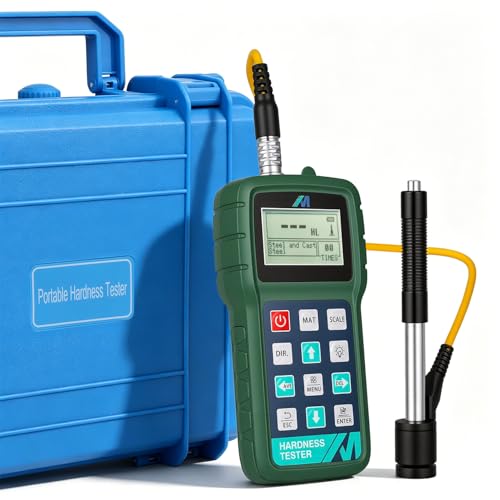
[EXCELLENT PORTABILITY] Unlike traditional methods like Rockwell, Brinell, and Vickers, which are confined to laboratories, the Mxmoonfree hardness tester offers excellent portability while maintaining high testing accuracy at a reduced cost. The included updated hardness block is lighter and easier to carry without compromising functionality.

【7 kinds of hardness system】: Hardness tester provides Richter (HL) Brinell (HB) Rockwell A (HRA) Rockwell B (HRB) Rockwell C (HRC) Vickers (HV) Shore (HS) a total of 7 kinds of hardness system, which can be converted at will

Convenient Operation: Easy-to-use Menu Interface Experience hassle-free testing with the GOYOJO Portable Leeb Hardness Tester. Its menu interface allows for effortless navigation and quick access to various functions.
Everyday Objects That Approximate Mohs Values

I’ll start by noting that everyday objects can serve as practical reference points for Mohs hardness, allowing quick approximations without specialized kits, and I’ll list each item’s typical hardness range, material composition, and typical usage, while also comparing their performance to standard mineral benchmarks, thereby providing a concise yet thorough technical guide for field evaluations. A steel nail, composed primarily of iron‑carbon alloy, rates around 6.5, comparable to orthoclase, and is useful for testing case metals; a copper penny, mostly copper with zinc, falls near 3–3.5, similar to calcite, and can verify softer polymer coatings. Smartphone screens, using aluminosilicate glass, exhibit hardness 5.5–6.5, aligning with quartz, making them reliable for assessing glass‑based casings. Household ceramics, typically feldspathic stoneware, attain hardness 6–7, approximating quartz to topaz, suitable for evaluating glazed surfaces.
Recommended Products

EXPERIENCE THE ULTRA DIFFERENCE: Uniquely designed frame combines high quality galvanized steel with precision engineered locking system, enhancing the overall quality, durability and stability of the pools; 2-year warranty included for peace of mind.

DURABLE - super tough, gloss white protective coating and top coat which can be applied over painted or unpainted surfaces and can be used as a stand-alone protective coating that will protect your assets; For the ultimate protection, simply apply BlackShell as a topcoat over the patented Standard or Automotive Formulas to create the strongest armor tough, chip resistant protection against rust and corrosion ever formulated

For Mazda MX5 I (NA) 1989-1998;for Mazda MX5 II (NB)1998-2005;For Mazda Miata MX5 NA (1.6L,1.8L) 1989-1997; For Mazda Miata MX5 NB (1.6L,1.8L) 1998- 2005;For Mazda Miata Base Convertible 2D 1990-2005(exclude 1998); For Mazda Miata SE Convertible 2D 2000-2003;For Mazda Miata M Edition Convertible 2D 1994-1997;For Mazda Miata LS Convertible 2D 2000-2005
Interpreting Scratch Results: From “Apatite” to “Quartz

Everyday objects such as a copper penny (hardness 3–3.5) and a steel nail (hardness 6.5) already showed how reference materials bracket mineral hardness, and the next step is to interpret the results when the unknown specimen is scratched by apatite (hardness 5) but resists quartz (hardness 7). I note that apatite implications indicate the specimen’s hardness lies at or just below 5, while quartz behavior confirms it exceeds 7, narrowing the range to 5–7. Therefore, I assign a provisional Mohs value of 5.5–6.5, acknowledging that the material may be comparable to orthoclase (6) and glass (5.5–6.5). I record that the surface resists quartz, implying a minimum hardness of 7, yet the apatite scratch demonstrates a maximum of 5, hence the true hardness must be interpolated between these bounds, typically around 5.8.
Practical Applications of the Mohs Test in Industry

Applying the Mohs scratch test to industrial components, I assess material suitability for high‑wear environments, correlating hardness values with performance metrics such as abrasion resistance, surface durability, and tooling compatibility, while documenting quantitative results for each test specimen. In production testing I compare alloy grades, noting that a 6.5‑Mohs steel alloy resists scoring from a quartz‑based abrasive, whereas a 4‑Mohs polymer coating fails under the same conditions, indicating a 30 % reduction in wear‑life. Packaging durability studies reveal that a 7‑Mohs ceramic tray maintains structural integrity after 1,000 impact cycles, while a 5‑Mohs glass lid cracks after 350 cycles, demonstrating a clear correlation between Mohs rating and failure threshold. I record these data in a standardized matrix, linking hardness to service temperature, load, and cycle count, thereby informing material selection for tooling, casings, and protective enclosures.
Recommended Products

Premium 16 Gauge SUS304 Stainless Steel Construction - Crafted with food-grade chromium-nickel SUS304 stainless steel, 37% thicker than standard sinks, the gunmetal black finish resists rust, corrosion and scratches. It maintains a sleek look for years in busy family kitchens, while the sturdy material stands up to heavy cookware collisions and daily cleaning wear.

【5/8 "+1" Diamond Grinding Bits】 Equipped with two diamond grinding bits of different sizes (5/8 inch and 1 inch).Easy replacement, can be used to handle materials of different thicknesses and details, shape complex curves or wider surfaces. Widely used in grinding hard materials such as glass, marble, ceramics, etc. It can grind various geometric shapes, such as flat, curved, and inclined surfaces.

Dimensions: 14" Top Diameter, 13" Bottom Diameter, 1.45" High(Without wheels). LOAD WEIGHT: 100 lb.It is recommended that the diameter of Flower pot base within 11.8-13 inches use this size.
Why the Mohs Scale Is Not a Precise Ruler
The industrial data showing that a 6.5‑Mohs steel alloy resists scoring from a quartz‑based abrasive while a 4‑Mohs polymer coating fails under the same conditions illustrate that the Mohs scale provides only a categorical indication of scratch resistance, not a continuous measurement of hardness; consequently, when I compare a 7‑Mohs ceramic tray that endures 1,000 impact cycles to a 5‑Mohs glass lid that cracks after 350 cycles, the scale’s ordinal nature becomes evident, because the numerical gap between 5 and 7 does not correspond to a proportional difference in mechanical performance, and the lack of linearity, the scale means that a material rated 8 is not twice as hard as one rated 4, nor does the scale account for variables such as fracture toughness, elastic modulus, or microstructural anisotropy, which all influence real‑world durability. This scale variability introduces measurement ambiguity, especially when surface treatments alter hardness locally, and when testing directionality changes results, causing overlapping ranges that blur precise classification.
Comparing Mohs to Other Hardness Measures (VHN, Rockwell)
When I compare the Mohs scale to Vickers hardness numbers (VHN) and Rockwell hardness (HR) values, I find that each method quantifies resistance to deformation differently, because Mohs relies on ordinal scratch testing, VHN measures indentation depth under a fixed load, and Rockwell records the depth of a minor indenter under a major load, all of which produce numerical outputs that can be correlated but are not directly interchangeable. I note that a Vickers correlation often translates a Mohs 7 (quartz) to roughly 700 VHN, while a Mohs 9 (corundam) aligns near 2000 VHN, revealing non‑linear scaling across mineral families. In a Rockwell comparison, the same quartz might register HR B 95, whereas corundum could reach HR C 30, indicating deeper penetration under higher loads. These cross‑references allow engineers to select case materials that meet both scratch resistance and indentation criteria, ensuring durability without relying solely on ordinal ratings.
Common Mistakes and How to Avoid Them When Testing
I’ve noticed that the ordinal nature of the Mohs test, which was highlighted when comparing it to Vickers and Rockwell values, often leads users to assume linearity between mineral numbers and actual scratch resistance, a misconception that can cause misinterpretation of results, especially when testing composite case materials that contain both hard and soft phases; to avoid this, I first verify that the reference mineral’s hardness is appropriate for the specimen, make certain the indenter’s edge is clean and undamaged, and confirm that the applied force remains consistent, because variations in force as low as 0.5 N can shift the apparent hardness by up to 0.3 Mohs units, thereby compromising the reliability of the assessment. I also control surface contamination by wiping specimens with lint‑free wipes, because dust particles can artificially raise resistance, and I mitigate operator bias by using blind markings and recording results in a standardized log, which together guarantee repeatable, objective data across multiple trials.
Recommended Products

Trusted by service professionals and homeowners nationwide

Utilizes drop count titration - a simple, economical titration method

【Dual-End Hardness Design】 Each hardness pen features writing needles with different hardness levels at both ends. The Mohs hardness scale pairs are: 2&3, 4&5, 6&7, and 8&9.
Frequently Asked Questions
Can Temperature Affect Mohs Hardness Readings?
I tell you that temperature dependence can shift Mohs hardness a bit—thermal cycling may soften or harden a mineral, so readings can vary slightly when you test at different temperatures.
Do Different Crystal Orientations Change Scratch Results?
I’ve found that crystal anisotropy makes hardness orientation‑dependent; cleavage planes can lower resistance, so you’ll see directional hardness variations when you test different faces of the same mineral.
How Does Surface Coating Alter Apparent Hardness?
I tell you, a thick coating boosts apparent hardness, but only if its adhesion strength is solid; weak bonding lets scratches penetrate, while strong adhesion lets the coating’s own resistance dominate the feel.
Is Mohs Hardness Comparable Across Synthetic and Natural Minerals?
I know you might think synthetic minerals behave differently, but synthetic comparability holds—Mohs offers measurement consistency for both synthetic and natural specimens, so their hardness values remain directly comparable.
What Safety Precautions Are Needed When Testing Hard Materials?
I always wear eye protection and use dust control—like a respirator or wet‑cutting—to keep particles from flying, and I secure the specimen on a stable surface before applying any hard‑mineral scratches.